
Cities Are Not Background
What happens when you stop moving through a city and start paying attention to it

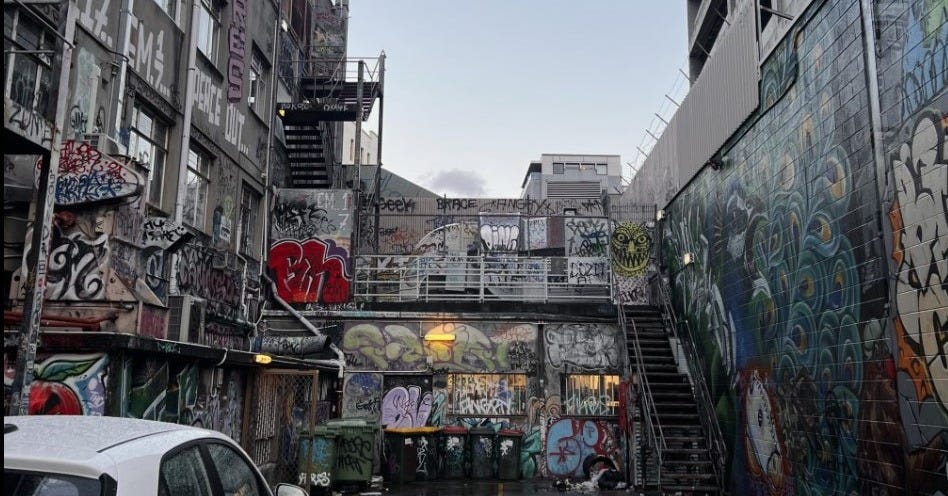
Yesterday I noticed an alley in the city that I’m absolutely certain had never been there before.
It was just across the road from where I was walking, a narrow gap between buildings running off into graffiti and industrial sized garbage bins. I stopped, looked again. Still there. I swore I hadn’t seen it before.
It had been there all along. Of course it had.
Still, it did send my brain cartwheeling briefly into directions reminiscent of The City and the City (China Miéville, great book) and threatened to start a weird, manic twitch in one eye.
Why hadn’t I noticed it before?
My whole thing is building relationships with urban places, and apparently I’d just had a catastrophic failure at noticing a very obvious alley. What a winner.
After a few moments of rationalising I realised what had happened. I was approaching from a slightly different angle than usual, and there were a couple of skip bins positioned oddly nearby (that’s my excuse and I’m sticking to it). My brain had done that familiar trick of deciding something was new simply because I was seeing it differently.
Still slightly unsettled, I grabbed a seat on a nearby bench and stared at the now very un-mysterious alley.
Moments like that do happen occasionally — suddenly noticing something in a place you know well. But this one made me think about something more fundamental.
How often do we actually see the city?
I don’t mean glancing around while walking somewhere. I mean really noticing the place we’re moving through. Probably not very often.
Most of us pass through cities on our way to somewhere else. We’re heading to work, to an appointment, to home. Even when we’re not in a rush, our surroundings tend to blur into the background. Bridges, footpaths, stairwells, poles, culverts — all the infrastructure that makes urban life possible — fades into something like scenery.
Cities become background. But that changes surprisingly quickly when your attention shifts.
Over the past few years I’ve spent time deliberately paying attention to urban places. Or, to put it more succinctly, attending with parts of the city. This doesn’t necessarily mean anything dramatic, like a ritual with robes, candles, and magical sticks, although it could. What I generally mean by attending with is sitting with them, returning to them, letting them reveal themselves slowly. Once that attention stabilises, small things begin to change.
Something as mundane as a streetlight next to a carpark can transform as a result of sustained attending. A pole I passed every day went from being invisible infrastructure to a quiet marker in the landscape. When I spent time with it, it began to feel like a point of stillness — a place holding its own rhythm of light, weather, and presence, while also grounding me more fully in where I was.
Something similar happened with a culvert near the bottom of my driveway. For the first year after we moved in I barely registered it. Just a concrete drainage channel doing what drainage channels do.
But after repeated visits and spending time attending to the area, the culvert began to feel less like an object and revealed itself as it actually was - a sentinel watching over a place where water, weather, soil, and infrastructure interacted in ways that were anything but inert.
Although my attention had changed, these places were already in relationship with everything around them - the weather, water, season, each other. Directing my attention made me available to something that was already happening without me. It wasn’t me creating anything new.
And once that shift happens, once you take the time and be a little bit deliberate, cities start to look very different.
We’re often taught, explicitly or implicitly, that nature is alive and cities are not. Forests are vibrant. Rivers have spirit. Meadows feel enchanted.
Cities, on the other hand, are usually imagined as inert spaces. Concrete environments built for human use, spiritually empty and largely devoid of life beyond the people and animals moving through them. But that division starts to fall apart when you spend time paying attention to urban places.
Streetlights, culverts, bridges, stairwells, and drains stop feeling like background scenery and begin revealing themselves as parts of a complex living environment.
Not nature versus city. Just different kinds of places, with different kinds of presence.
Urban animism practice grows out of that shift in perception. It doesn’t require believing anything new so much as learning to notice what’s already there. Cities are not just settings we move through. They are places full of relationships, rhythms, and presences interacting with each other and with us. The strange thing is that nothing about the city has to change for this to become visible.
For people who work with animist practice, that shift in perception is not just psychological, or pure woo. It’s relational. Attention doesn’t simply change how the city appears, it changes how we participate in it. Places that once felt inert begin to reveal themselves as animate in their own right: bridges with moods, culverts with their own thresholds, streetlights that hold a corner of the night. Not metaphors, but encounters.
And once you start noticing a city that way, it becomes very difficult to go back to treating it as background.
Esoteric Potato explores urban animism — the practice of building relationships with the places, structures, and ecosystems that make up our cities.